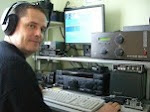
I had the thought that before I purchased the K3 second receiver, I would experiment with SO2R using the K3 and the K2. I use WinTest contesting software and this has a dual logging/sending facility (SO2R) that allows 2 rigs to be connected. I had been under the impression that you needed one of those fancy SO2R boxes to get started, but soon realised that there are many different levels of automation in SO2R, from none to completely automated.
The one prerequisit as far as I'm concerned is to be able to hear both radios through 1 set of headphones. I did this with the following bits I had around the shack:
2x stereo headphone jack to two mono sockets
2x mono to stereo adapter
1x 3 way 3 pole switch box
The radios in their current configuration basically output 2 mono channels each. One on the tip and one on the ring of the headphone socket. I used 2x stereo to two mono splitter leads (available from maplin) to allow various combinations of audio at the input of the switch box:
1) Rig 1 tip to headphone tip, rig 2 tip to headphone ring.
2) Rig 1 ring to headphone tip and ring (using mono to stereo adapter).
3) Rig 2 ring to headphone tip and ring (using mono to stereo adapter).
With the headphone plugged into the output of the switch box, I can now select from the above combinations to hear the K3 in my left ear and the K2 in my right ear or the K3 in both ears or the K2 in both ears. I was worried about mixing the earth connections from the headphone sockets of both rigs but in practice this seemed to work fine.
To help prevent interaction between the radios when transmitting from one, I have cut 2x 23' coaxial stubs (one shorted and one open circuit). I have assigned the K3 to operate on 40/15m and the K2 to operate on 20/10m. A tee piece spur from the coaxial line from each rig provides the connection point for each stub. The shorted stub is connected to the k3 coax as it filters 20/10m and passes 40/15m. The open stub is connected to the K2 coax and it filters 40/15m and passes 20/10m. This will hopefully allow me to simultaneously run on one radio and S&P on the other without too much interference.
Wednesday, 12 November 2008

K2, Z10000-K2 buffer amp and SoftRock V6.2Lite
With the K3 panadapter being so successful, I decided to go back to Clifton Labs to see if they had a solution for my K2. The K2 doesn't have an IF out socket on the rear panel like the the K3, but luckily Clifton Labs sell a complete kit allowing the Z10000-K2 buffer amp to be installed inside the K2 with provision for a rear panel socket.
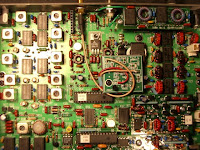


The above picture shows the Z10000-K2 daughter board mounted inside the K2 with output IF coaxial connected to the rear panel (top of picture). The input IF is taken from a convienient point on the noise blanker board connection posts.
I then contacted Tony Park for a K2 Softrock (4.898MHz IF). When finished, this was connected to the new IF output from the K2. The AF output from the softrock was then connected to my Delta 44 sound card. Rocky software then uses the sound card inputs to provide the panadapter.
I'm really pleased with the result and it makes a huge difference seeing signals round about you.
Tuesday, 28 October 2008
MM3T (CQWW Phone 08)
In preparation for CQWW I bought a BE102 mast support from Lynchy and 2x 5m 16swg ali poles from http://www.metals4u.co.uk/. The plan was to get a Cobweb (multi-band dipole) up at least 9m in the air for 20-15-10m. It was all installed a couple of weeks before the contest and I was getting good reports from the cobweb at around 9m over the ground. I lowered the antenna back down to ground level for safety so that it would be ready for CQWW phone 08.
I got home from work early on the Friday before the contest and put up the cobweb. It was up about 3 hours when the winds started to howl and I decided that since I wasn't using it through the night, I'd lower it and then raise it again on Saturday morning.
Saturday morning came and the winds started to rise yet again. I looked at the weather reports and found it was only going to get worse so rather than risk the antenna I left it at ground level. It was a fearsome gale, about force 7-8 and would definately have brought the antenna down. During all this time I was using my 80m doublet to keep the Qs going.
Sunday morning came and at last the wind died down so I went outside to put the antenna up. Never try and put up an antenna when you are tired! I made so many mistakes it took my twice as long as it usually did, but finally it went up and I hurried indoors to start the scores rolling properly on the higher bands.
I was on 15m and running the full legal limit when I got a knock at the door and a report that I was coming through computer speakers next door. Well, the linear was switched off and I spent the rest of the contest at 100w.
My contest turned out to be a disaster but lessons were learned for the CW leg which is the important one for me anyway.
1) I've ordered a thicker walled pole (10swg) for the bottom 5m mast section, to try and increase it's wind survival spec.
2) I've ordered a 12m spiderpole for a 40m vertical as my 40m score was pityful.
3) Try and get all antennas up before the contest and don't try and change things when I'm tired.
4) Remember to go to 20m early morning for the JA run and not just play on 80/40.
5) Order some ferrite rings for next door.
Hopefully CQWW CW will be better.
Wednesday, 27 August 2008
One reason to buy an Elecraft K3
In the past I've bought radios and discovered that they were slightly deaf or off frequency. I found it frustrating that I didn't have the test equipment or the knowledge to align the radio and obtain the specified performance of when the radio was new. I'm not talking about a misused radio, just what happens to all radios through age due to high temperatures slowly changing the tolerances of components.
With the Elecraft K3 I can align the frequency readout at any time with an accurate source like RWM (9.996 or 14.996 MHz). This means that the radio will always be exactly on frequency independant of age. I can do this with no test equipment and in no time at all.
One of the causes of a radio going deaf is the IF wandering outwith the centre of the IF filter passband. With the Elecraft I can use it's internal test resources to measure the response of any roofing filter and I can work out if signals are still central to the filter passband and adjust the IF accordingly.
This means I should be able to maintain my radios performance to a higher degree for as long as I choose to hold on to the radio, without the need for specialist knowledge or elaborate/expensive test equipment.
Priceless!
Sunday, 17 August 2008
K3 Panadapter SoftRock V6.2 Lite
Managed to complete the above project for my K3. I really must recommend this panadapter, now after switching on the K3 the first thing I do is start Rocky and have a 'look' around on 10 and 6m for openings. On several occasions whilst tuning the K3 and hearing a flat band, I've had to reverse tune on seeing a spike jump up on the screen, and as a result completed a contact on what at first seemed like a flat band.
It all started when I came across the following website:
http://www.cliftonlaboratories.com/using_softrock_as_a_panadapter_for_the_k2.htm
This page gives the details on how to purchase a K3 SoftRock V6.2 lite. In my e-mail to Tony Park's I mentioned that it was for use with the K3 IF and also the offset crystal frequency of 8.191MHz. He will also give you postage costs to your home location but the price of the Softrock is currently around $12. I paid using PayPal which was very convenient.
I also bought the Z10000U (general purpose) buffer amp board from Clifton Laboratories to help with reverse isolation between the SoftRock and the K3. I didn't try the softrock without the Z10000U in-line, but with it there is no evidence on the K3 rx of the panadapter being there. I used the 150 Ohm resistor for R907 to set the gain of the buffer amp to 6.7dB. I haven't experimented with different values as this seemed to work sufficiently for my needs. To this date I haven't bothered with the optional bandpass filter.
http://www.cliftonlaboratories.com/z10000_buffer_amp.htm
http://www.cliftonlaboratories.com/z10010_bandpass_filter.htm
The build presented no problems except you have to be capable of working with surface mount components. All in all it took me 5-6 hours to get it all up and working with the K3. I then boxed both boards up in an Altoids tin.


With the tin open you can follow the signal path from the LHS BNC connector (connected to KXV3 IF out) through the Z10000U buffer amp (LHS card) then linked with coax to the SoftRock (RHS card) then finally out on a screened jack3.5mm stereo socket (top right) to the sound card.

Here we can see me writing this article with Rocky software running at the bottom of the screen. I'm listening on the K3 to the small spike shown at the centre of the display. I find it really useful to see what's happening round about where I'm listening to. I've seen huge spikes right next to me and not been able to tell they were there on the K3 :-).
My K3 has the following roofing filter options: 2.7/2.1/1/0.4 KHz.
When using the panadapter it is interesting to listen to the K3 audio output in cw mode and look at the IF output when switching between filters. My 2.7KHz filter has a specified shift of -0.93KHz which is corrected in firmware to correctly line up with the IF. On the panadapter it is clear that the IF actually shifts to correct this error, as all visible signals bounce to the right by approx 1.5KHz in comparison with the 400Hz roofing filter. My Inrad 2.1KHz (0KHz offset) roofing filter also causes signals to bounce to the right but this time by only 500Hz. There is no shift between the 1KHz and 400Hz roofing filters. Whilst switching between these roofing filters, there is no difference in pitch from the audio output. It would seem from these very rough observations that the IF is shifted up by approx 500Hz (plus any offset) when using the 2.7/2.1 filters in comparison to the 1/0.4 IF. I imagine this extra shift for wide filters brings the 700Hz pitch cw signal more to the centre of the filter passband i.e. 1.2KHz. Any thoughts?
The same shift happens on transmit and means that you cannot align your tx and rx on screen. I had thought about buying the INRAD 2.8KHz filter to lose the 0.93KHz offset, but I would still get the 500Hz shift so probably not worth it on cw.
The panadapter is very useful for the identification of noise sources. Without one it's very easy to connect up a new SMPS or Router in the shack and and after a quick tune around believe it to be noise free. With the panadapter it is instantly obvious that noise has appeared, so far I've had to assign a laptop power supply to the bin and can also see the squirmy warble associated with my 2 SMPSs (Alinco DM-330MW and MFJ 4125). Anyone who believes these to be noise free could benefit from a panadapter :-).
Wednesday, 30 July 2008
Elecraft K3 sn1293 is born!
The K3 arrived whilst I was preparing for IOTA. I managed to build it to the 10w stage in 12 hours. The 100w stage took an additional 2 hours. The build was straight forward and well documented.

As can be seen from the above picture, there are lots of bits to assemble and close attention has to paid to the types of screws and washers used for each part of the assembly. Other than that, if you have put a computer together in the past then this will present no problems.

Before long you start to see the radio taking shape and the exitement starts building. I had planned to do 6 hours and then have a break, but like a good book, I just couldn't put it down.
The K3 is an excellent transceiver and to date I've yet to find something that doesn't work :-).
IOTA 08
Well it's all over now for MM3T on EU8 Islay. I had great fun and managed to make 460Qs over 12hrs on CW with 100w and a doublet.

Here I am sitting near Carraig Fhada Lighthouse (Port Ellen) with the 'singing sands' in the background. I'm out in the open and it's about 22:30BST. I'm using WinTest for logging and the light from the screen was enough to see the keyboard by (just). The midges were biting as there was so little wind, but other than that the conditions were perfect.

Here you can see the Elecraft K2/100 sitting on the trolley I used to get the battery up to this vantage point. The case I use for the carrying the K2 helped bring it up to a convenient level. Out of sight is my WinKey USB and taped to the trolley handle is my LDG Z11 pro and Elecraft BL2 switchable balun. You can just see the 300 Ohm feeder (bottom left) going to a doublet mounted on a 10m fishing pole behind me.
It wasn't all plain sailing though as Murphy visited the station just before the start of the contest. I had been in the K2 menus configuring the PA fan to run on HI continuously and accidentally changed an adjacent menu entry. The result was that there was no sidetone and no rig control! Luckily I had brought a small laminated manual (Nifty K2 manual) and after 20 mins of reading was able to return the K2 to full operation...phew!
There seemed to be a distinct lack of UK stations on air, as when I did find one they were LOUD. I can only imagine that the brilliant weather proved too much for most UK hams to stay indoors for the contest.
Subscribe to:
Posts (Atom)