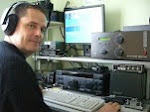
Active as GM4AGG/P this weekend for NFD with Terry GM3WUX. Using N1MM, Elecraft k3 and top band doublet.
Used dual receive capability of the K3 all contest. N1MM really helps allowing easy tx switch between main and sub rx frequencies:
ctrl-right arrow : tx to sub freq
ctrl-left arrow :tx back to main freq
In this way you can run on the main whilst s&p on the sub. This is easy to say but not easy to do efficiently.
Notes to self :
1) Always use full break-in whilst doing the above, it allows tuning the sub whilst txing on the main. You can tell when you've got a hot one in the sub even before you finsh a CQ.
2) Main and Sub CW speeds in N1MM are separate (cool).
3) RIT is up and down arrow
4) Speed is page up and page down
5) The volume control on the K3 may be better with it configured as a balance control
Terry can do this himself, but it's easier with a buddy who understands whats happening and who is also listening to both rxs. The buddy can help by constantly tuning the sub finding running stations in the contest. He also controls the volume by following the operators tx indication on the K3 LCD. When a weak one calls the volume of the sub/main can be reduced to help the operator 'tune-in'. In this way the operators hands never leave the keyboard.
With just 2 operators for 24hrs we managed to beat last years score despite worse conditions. The only difference was using the dual rxs in the K3. We also had 1 hr down-time this year due to a faulty PSU.
last year 940Qs, this year 1070Qs
Sunday, 5 June 2011

Tuesday, 3 May 2011
GB5TI cw pile-ups
During GB5TI we were mostly using the K3 in split mode (tx on B VFO, rx using A VFO) I initially set the radio for 1KHz split up. This served to get the rate back up as the pile-up could now hear me.
Notes to self:
1) Always use QSK when calling for split DX. During GB5TI I realised that some operators would keep sending their callsign until I sent anything then they stopped. If I waited they just kept sending with hardly any gap. If I got a complete call I could go back without hesitating after the last letter. If they weren't on QSK it invariably went quiet after I sent their call as we both doubled on his second time through his callsign. I wanted to try to set a single call rhythm but that's hard to do when people aren't using QSK.
2) During GB5TI I would occasionally forget to tune the A VFO about after working the last station in the pile. I couldn't believe the number of stations that weren't listening for the stations I was working to find my rx frequency. Instead they would be blindly calling 2KHz up or something and eventually I'd find them even although they were 59 and the last stations in the pile were 51. When you finish the pile the temptation is to reset to 1KHz up and call CQ again. At home, if I'm not the default 1KHz up and I hear the op calling CQ I'll now try tuning to 1KHz up +/- a few hundred hertz especially if only "up" is sent.
3) I found that opening the width control (DSP filter coupled with automatic roof filter selection at key points) right up to around 800Hz DSP with 1KHz roof filter (deselecting the 400Hz roof filter) was the best setting at the height of the pile-up. This way I could pick off the highs and the lows without taking my hands off the keyboard. It also meant that the pile-up spread out as stations jumped off the centre frequency to tail end the last station worked. This stops the pile-up guessing listening frequency patterns/tuning directions and a nice even spread emerges.
4) At the height of pile-ups, as I'm less than a little pistol, calling immediately is pointless as the strongest station invariably wins. Better to hold off a callsign length or two and then pop one in lower than the suspected listening frequency.
5) Always remember to disengage split after working the DX. On a number of occasions I heard stations I'd already worked randomly sending their callsigns on my listening frequency. After several attempts to re-work a specific Russian station I realised he had just forgotten to disengage split.
Notes to self:
1) Always use QSK when calling for split DX. During GB5TI I realised that some operators would keep sending their callsign until I sent anything then they stopped. If I waited they just kept sending with hardly any gap. If I got a complete call I could go back without hesitating after the last letter. If they weren't on QSK it invariably went quiet after I sent their call as we both doubled on his second time through his callsign. I wanted to try to set a single call rhythm but that's hard to do when people aren't using QSK.
2) During GB5TI I would occasionally forget to tune the A VFO about after working the last station in the pile. I couldn't believe the number of stations that weren't listening for the stations I was working to find my rx frequency. Instead they would be blindly calling 2KHz up or something and eventually I'd find them even although they were 59 and the last stations in the pile were 51. When you finish the pile the temptation is to reset to 1KHz up and call CQ again. At home, if I'm not the default 1KHz up and I hear the op calling CQ I'll now try tuning to 1KHz up +/- a few hundred hertz especially if only "up" is sent.
3) I found that opening the width control (DSP filter coupled with automatic roof filter selection at key points) right up to around 800Hz DSP with 1KHz roof filter (deselecting the 400Hz roof filter) was the best setting at the height of the pile-up. This way I could pick off the highs and the lows without taking my hands off the keyboard. It also meant that the pile-up spread out as stations jumped off the centre frequency to tail end the last station worked. This stops the pile-up guessing listening frequency patterns/tuning directions and a nice even spread emerges.
4) At the height of pile-ups, as I'm less than a little pistol, calling immediately is pointless as the strongest station invariably wins. Better to hold off a callsign length or two and then pop one in lower than the suspected listening frequency.
5) Always remember to disengage split after working the DX. On a number of occasions I heard stations I'd already worked randomly sending their callsigns on my listening frequency. After several attempts to re-work a specific Russian station I realised he had just forgotten to disengage split.
GB5TI cw pile-ups with N1MM
I have used N1MM twice before, enough to be able to log with it, but never in any great detail. Initial CQ calls brought one or two callers then we were spotted and all hell broke loose. I'd never operated split with N1MM before and instantaniously hit problems:
1) If I tuned the A VFO over the pile-up the software took me out of run mode and sent the S&P macros instead. I noticed it doing it and got into the routine of putting it back in run mode every time it jumped out. Later (and after much swearing from me) Gordon MM0GPZ found a selection in the setup menus to stop this happening.
2) I had to use the key to send partial calls to whittle the pile-up. The tent was freezing and the tent walls were flapping off my key hand making things difficult. If I tried to use ESM it tried to log the partial call. The solution was known by Bill GM4ZNC who recommended I type a ? after the partial call which served to send the partial call query but not to try and log it. Then it highlighted the ? ready to be over-typed with the full call.
3) Two or three times whilst trying to edit the callsign field, N1MM would engage the RIT and move my RX frequency. This might be a handy feature for casual operating, but was a real pest for me during GB5TI. I now know that this was due to me accidentally pressing the up or down arrow keys when editing the callsign field.
1) If I tuned the A VFO over the pile-up the software took me out of run mode and sent the S&P macros instead. I noticed it doing it and got into the routine of putting it back in run mode every time it jumped out. Later (and after much swearing from me) Gordon MM0GPZ found a selection in the setup menus to stop this happening.
2) I had to use the key to send partial calls to whittle the pile-up. The tent was freezing and the tent walls were flapping off my key hand making things difficult. If I tried to use ESM it tried to log the partial call. The solution was known by Bill GM4ZNC who recommended I type a ? after the partial call which served to send the partial call query but not to try and log it. Then it highlighted the ? ready to be over-typed with the full call.
3) Two or three times whilst trying to edit the callsign field, N1MM would engage the RIT and move my RX frequency. This might be a handy feature for casual operating, but was a real pest for me during GB5TI. I now know that this was due to me accidentally pressing the up or down arrow keys when editing the callsign field.
Monday, 2 May 2011
GB5TI Island of Lunga EU108 (Treshnish Islands) photos
GB5TI EU108
Well it's all over, hope you worked us! Some initial pictures of the operation:

Landing on Lunga is tricky when carrying equipment, then there's the boulder field to clamber over.

(l to r) Jim MM0BQI, Cary, Gordon MM0GPZ, David GM4WLL, Bill GM4ZNC, Doug GM0ELP

GB5TI operating site on Lunga, verticals (l to R, 40m,80m,20m) as near the salt water as we could get.

Me on a short break exploring Lunga
Thanks for the contacts and for stopping by.
Well it's all over, hope you worked us! Some initial pictures of the operation:

Landing on Lunga is tricky when carrying equipment, then there's the boulder field to clamber over.

(l to r) Jim MM0BQI, Cary, Gordon MM0GPZ, David GM4WLL, Bill GM4ZNC, Doug GM0ELP

GB5TI operating site on Lunga, verticals (l to R, 40m,80m,20m) as near the salt water as we could get.

Me on a short break exploring Lunga
Thanks for the contacts and for stopping by.
Hams4hams 18m pole on Lunga EU108
I've previously posted details about the Hams4hams 18m pole, but haven't tested it out in anger. I can now rectify the situation as it was used by GB5TI to support an 80m 1/4 wave vertical antenna over a 4 day period on the island of Lunga EU108. The clamps were all made up as suggested in the instructions and they worked perfectly to stop the pole collapsing down. The provided lower material guying collar was used as it seemed to slide down to the correct height for the first guying point. The second (smaller) material guying collar wasn't used as when pushed down the pole it seemed to stop at a point too high up the pole after the first guying point for our installation. We settled for a second guying point 1 section lower than the smaller guying collar allowed. The pole remained perfectly errect through long periods of gusting winds up to about 30 mph. The team were all impressed with the pole and all members had experience with the other pole manufacturer and agreed the hams4hams pole was great value for money.

Saturday, 16 April 2011
GB5TI EU108 Treshnish Isles
Just announced and I'm going to be part of it (yeehah!). I hope I can do it justice, I'll knacker myself trying no doubt. Gordon MM0GPZ is picking me up at the house in Hamilton at an unearthly time on Thursday 28th, we need to catch the first ferry from Oban to Mull and then make our way to the boat thats been charted by MM0BQI to Lunga. If all goes well we should be on the air late afternoon, probably 20 and 15m (CW and SSB). There are only 4 of us for a 4 day operation so please be patient with us as sleep deprivation creeps in.
Saturday, 12 February 2011
Elecraft XV144 offset fault solution
Well hats off to Elecraft, they've come up with a fix for the "offset fault" I reported. Seemingly they had a crystal supply problem in the last year or so and ended up swapping their supplier. Unfortunately the new supplier is providing Crystals marked 116.010MHz. These crystals are obviously 10KHz out from the original 116.000MHz ones.
The Elecraft K3 and K2 transceivers will only correct +/- 10KHz offset in firmware so any inaccuracy in the +ve side of the new 116.010MHz crystals renders the transceiver "off frequency". Unfortunately this was the case with my supplied crystal.
The Elecraft fix involves cutting a link and adding an adjustable inductor coil to "pull" the 116.010MHz crystal within the offset capability of the K3/K2 transceivers.
I decided that after paying the extra money for the crystal oven option, I would rather have a more accurate crystal inside the oven rather than "pull" the crystals frequency using a coil outside the oven. I have now replaced the crystal with one from a local supplier:
QuartsSLab (+442071006357)
Description:
HC49u, 5th Overtone - 116MHz, series o03s
Price £21.83
This replacement crystal now brings the XV144 up bang on frequency. Now to get on with using it :-).
The Elecraft K3 and K2 transceivers will only correct +/- 10KHz offset in firmware so any inaccuracy in the +ve side of the new 116.010MHz crystals renders the transceiver "off frequency". Unfortunately this was the case with my supplied crystal.
The Elecraft fix involves cutting a link and adding an adjustable inductor coil to "pull" the 116.010MHz crystal within the offset capability of the K3/K2 transceivers.
I decided that after paying the extra money for the crystal oven option, I would rather have a more accurate crystal inside the oven rather than "pull" the crystals frequency using a coil outside the oven. I have now replaced the crystal with one from a local supplier:
QuartsSLab (+442071006357)
Description:
HC49u, 5th Overtone - 116MHz, series o03s
Price £21.83
This replacement crystal now brings the XV144 up bang on frequency. Now to get on with using it :-).
Subscribe to:
Posts (Atom)